Shadows Learn About Distance
Sun shadows now soften with occluder distance: crisp where a pole meets the ground, increasingly soft toward the tip of its shadow, the way actual sunlight behaves. The shadow_filter pin on every light node finally does something, with four filters to pick from.
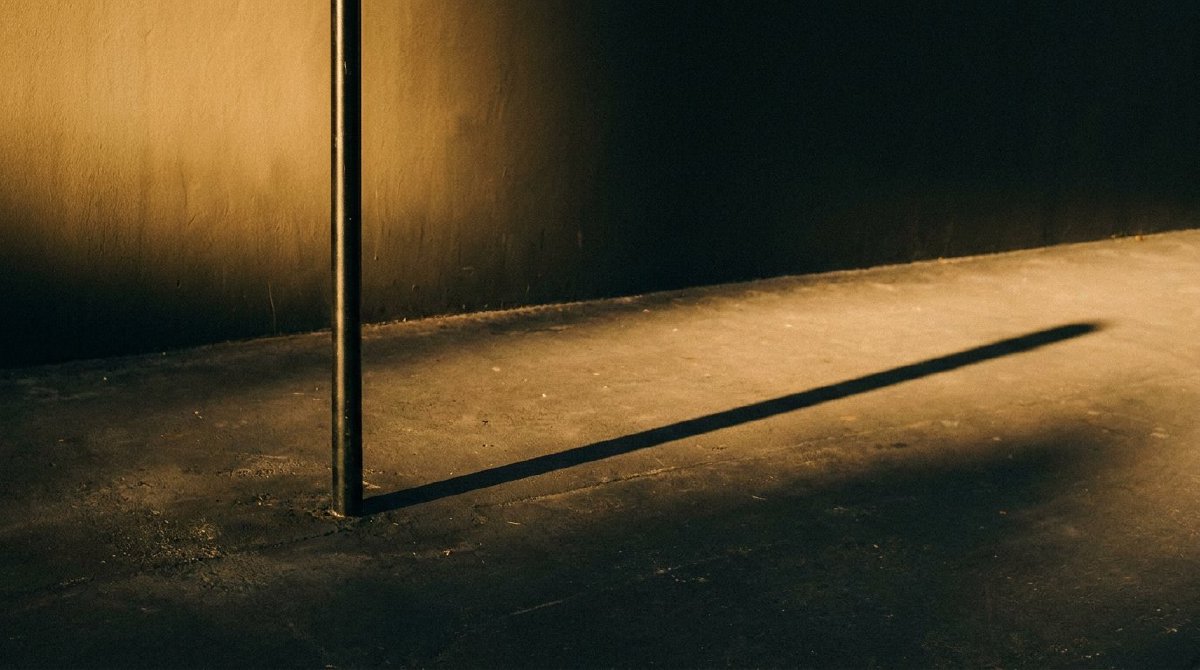
Real sunlight has a tell. Where an object touches the ground its shadow is razor sharp, and the further the shadow stretches from whatever casts it, the softer its edge becomes, because the sun is not a point, it is half a degree of sky. Renderers fake this with PCSS: search for the blocker, estimate how far it is, widen the filter accordingly. Lux’s sun shadows have been uniform 3×3-filtered everywhere, which reads as “video game” to anyone who has seen a fence at golden hour.
This release lands the full blocker-search pipeline in the cascade path. A standing pole’s shadow is now contact-sharp at the base and measurably wider at every step toward its tip, verified by a gate that scans the rendered edge at three distances and insists the widths strictly increase. The penumbra estimate follows the textbook formula, anchored by the analytic tests that have been waiting in the suite since the design phase for exactly this day.
A pin wakes up
Every shadow-casting light node has carried a shadow_filter pin with four options since the shadow system was designed: hard, pcf, pcss, stochastic. Until now the renderer read none of them. The pin is live: hard gives you a razor edge for stylized looks, pcf keeps the old uniform 3×3, pcss is the soft default, and stochastic trades the PCSS kernel’s banding for film-grain noise. The selection gate renders the same scene through three filters and counts gradient pixels: hard 322, pcf 454, pcss 786. Different settings, visibly different shadows, as a settings pin ought to work.
PCSS is the default, because soft shadows that respond to distance are what light does, and the entire existing shadow test fleet, acne gates, peter-panning gates, the 48-direction sun sweep, passed on the new default without a single threshold adjusted.
What it buys you
Set a light, get believable shadows without touching anything. Flip the pin to hard for graphic-novel looks or stochastic for grain. And a pole at sunset finally looks like a pole at sunset, sharp at its feet, dissolving at the tip.